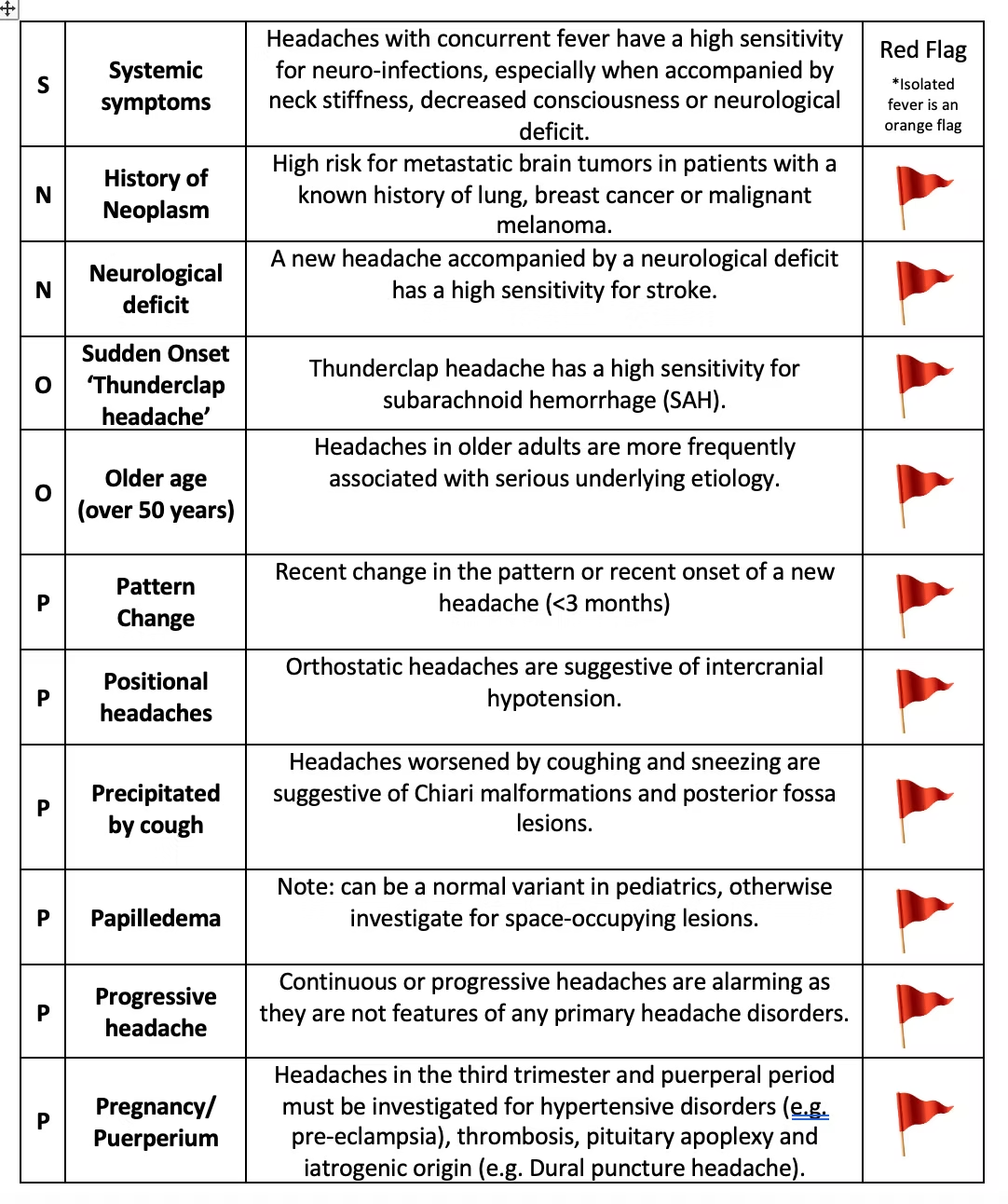
Features
- Sudden onset or accelerating pattern
- Maximum intensity of pain at onset (i.e. “thunderclap”)
- Worse with Valsalva
- Worse in the morning or at night
- No similar headache in past
- Age >50 yr or <5 yr
- Occipitonuchal headache
- Visual disturbances
- Exertional or postcoital
- Family or personal history of SAH](https://wikem.org/wiki/SAH “SAH”), cerebral aneurysm, or AVM
- Focal neurologic signs
- Diastolic BP >120
- Papilledema
- Jaw claudication
Clinical Context
Headache in setting of:
- Infection
- Cancer
- Immunosuppression
- [Seizure](https://wikem.org/wiki/Seizure_\(peds\) “Seizure (peds)”)
- Syncope
- Trauma
- Altered mental status
- Systemic illness (fever, stiff neck, rash)
- Nausea/vomiting
- Patient on anticoagulation, steroids, NSAIDs, antiplatelet
Initial Imaging
- For thunderclap headache, computed tomographic (CT) imaging of the head (CTH) without contrast remains the most appropriate, although CT arteriogram may be appropriate in certain circumstances.
- For new headache with optic disc edema, magnetic resonance (MR) imaging of the brain (MRIB) with or without contrast or CTH without contrast are usually appropriate, while CTH with contrast and CT or MR venography may be appropriate.
- New or progressive headache with “red flags” (e.g., subacute head trauma, exertional headache, neurologic deficit, cancer, immunocompromise, pregnancy, age ≥50) warrants plain CTH or MRIB with or without contrast.
- New primary headache of suspected trigeminal autonomic origin (e.g., cluster headache) should be investigated with MRIB, contrast recommended.
- For chronic headache with new features or progression, MRIB with or without contrast is appropriate (CTH with or without contrast may be appropriate).
- Imaging is not appropriate for newly diagnosed migraine or tension-type headache with a normal neurologic exam or for chronic stable headache with no neurologic deficit.
In most cases, neuroimaging for headache is unnecessary, but when it is, knowing which study to order is crucial. Improvements over previous criteria include a new umbrella “red flags” scenario, clarity that these criteria are for initial imaging only, and new references to additional criteria when secondary etiologies or contributors are present or suspected (e.g., stroke, sinonasal disease). Further, the addition of the most common scenario, primary migraine or tension-type headache without neurologic deficit, for which imaging is not appropriate, will help reinforce that in most cases, investigation is unnecessary beyond a careful taking of the history.