quick reference
Wheezy Puff Inhaler/Asthma/COPD Guide
Asthma
GINA Step
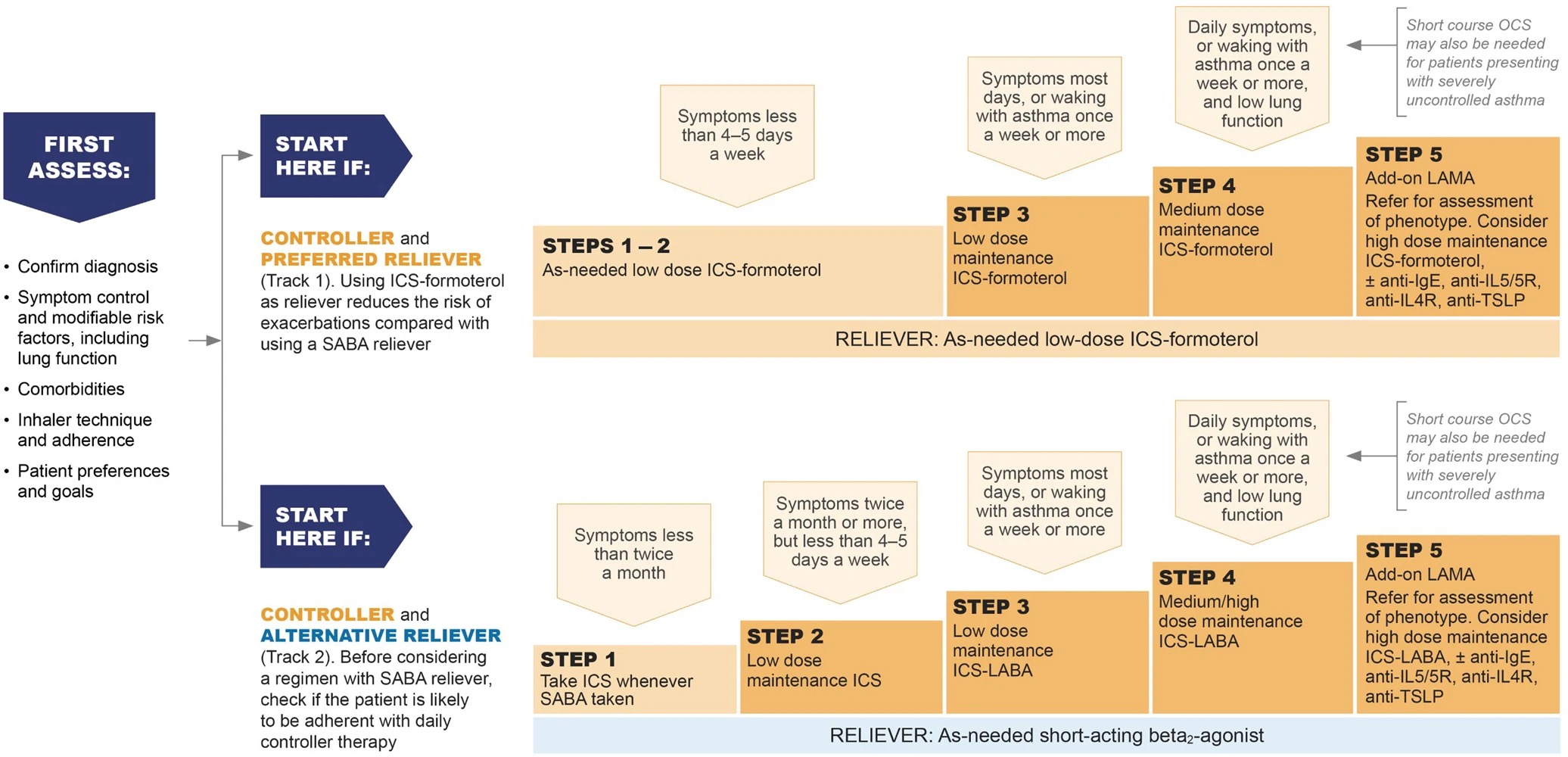
Step 1: Patients have infrequent symptoms (less than twice per month), no night waking due to asthma, and no risk factors for exacerbations. They require only as-needed low-dose ICS-formoterol (Track 1) or as-needed SABA with consideration of as-needed ICS (Track 2) for symptom relief. No daily controller is needed at this step.
• Step 2: Patients have symptoms more than twice per month but less than daily, or have risk factors for exacerbations. They require regular low-dose ICS or as-needed low-dose ICS-formoterol. This step is for those with mild persistent symptoms.
• Step 3: Patients have symptoms most days, or are waking due to asthma at least once per week, or have uncontrolled asthma on Step 2 therapy. They require low-dose ICS-LABA (or medium-dose ICS) as maintenance, or maintenance-and-reliever therapy (MART) with ICS-formoterol. This step addresses moderate asthma.
• Step 4: Patients have daily symptoms, frequent night waking, or exacerbations despite Step 3 therapy. They require medium- or high-dose ICS-LABA, or MART with higher doses, and may need additional controllers (e.g., LTRA, LAMA).
• Step 5: Patients have severe symptoms or frequent exacerbations despite Step 4 therapy. They require high-dose ICS-LABA and consideration of add-on therapies such as biologics (anti-IgE, anti-IL5/5R, anti-IL4Rα), LAMA, or low-dose oral corticosteroids.
COPD
1. Assess symptoms using a validated tool such as the modified Medical Research Council (mMRC) dyspnea scale or the COPD Assessment Test (CAT). A low symptom burden is defined as mMRC 0–1 or CAT <10; a high symptom burden is mMRC ≥2 or CAT ≥10.
mMRC (Modified Medical Research Council) Dyspnea Scale
2. Assess exacerbation history over the previous 12 months. Low risk is 0–1 moderate exacerbations not leading to hospitalization; high risk is ≥2 moderate exacerbations or ≥1 leading to hospitalization.
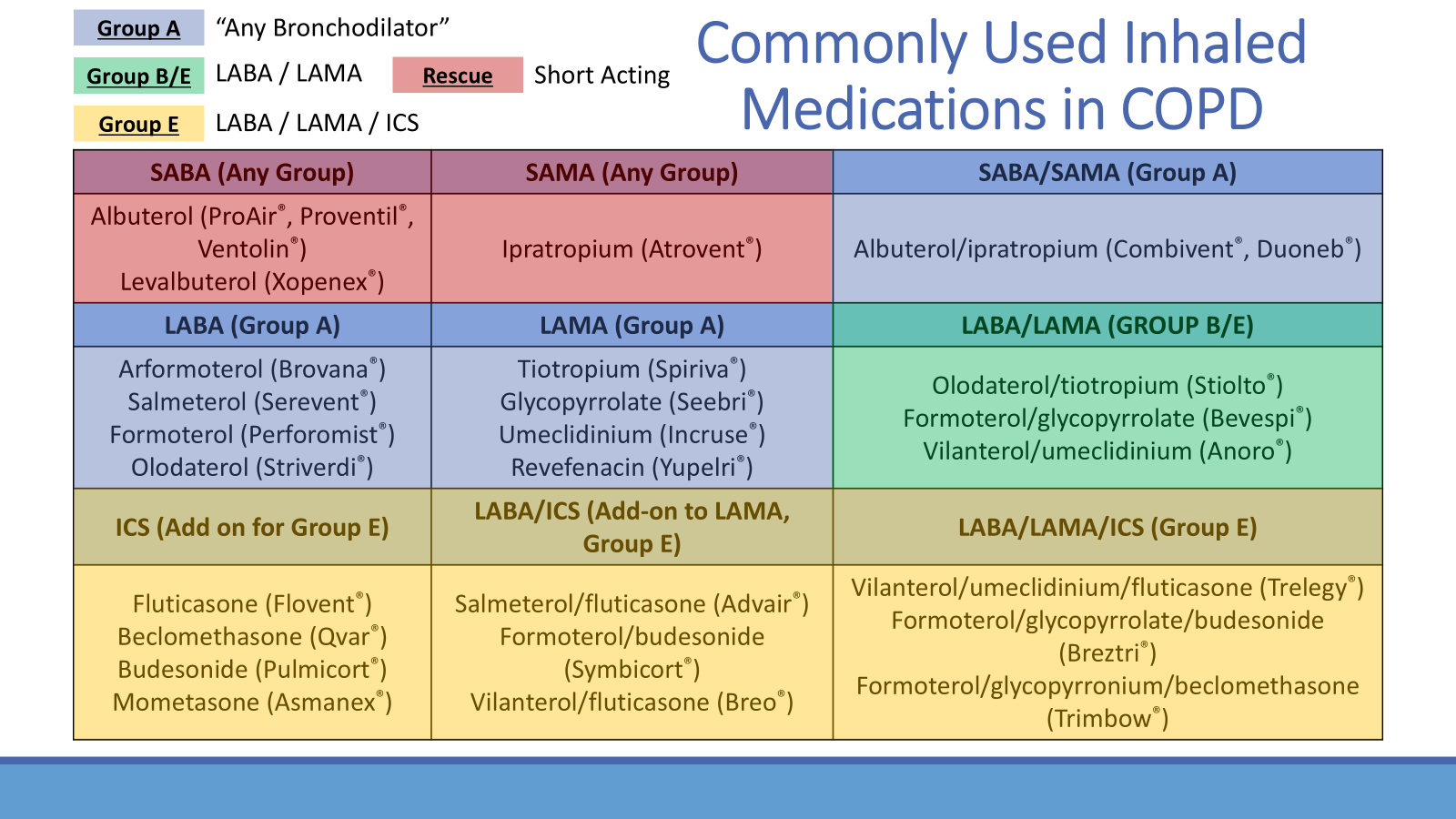
• Group A: Low symptoms (mMRC 0–1 or CAT <10) and low exacerbation risk (0–1 moderate, no hospitalizations).
• Group B: High symptoms (mMRC ≥2 or CAT ≥10) and low exacerbation risk (0–1 moderate, no hospitalizations).
• Group E: High exacerbation risk (≥2 moderate or ≥1 hospitalization), regardless of symptom burden.
pathophysiology
epidemiology / etiology
clinical features
diagnosis
treatment
COPD Exacerbation
- SABA/SAMA rescue:
- metered dose inhaler with 1-2 puffs once every hour for 2-3 doses (first 2-3 hours)
- 1-2 puffs every 2-4 hours based on the patient response.
- Once stable, transition to LABA/LAMA
- Use spacers or air-driven nebulizers when appropriate.
- BiPAP
- Oral Prednisone 40mg x 5days
- Consider Antibiotics
studies
GINA Guidelines - Asthma
GOLD Guidelines - COPD
Reduce Trial - 40mg prednisone x 5days in eCOPD