Alveolar Gas Equation - StatPearls - NCBI Bookshelf
The alveolar gas equation | Deranged Physiology
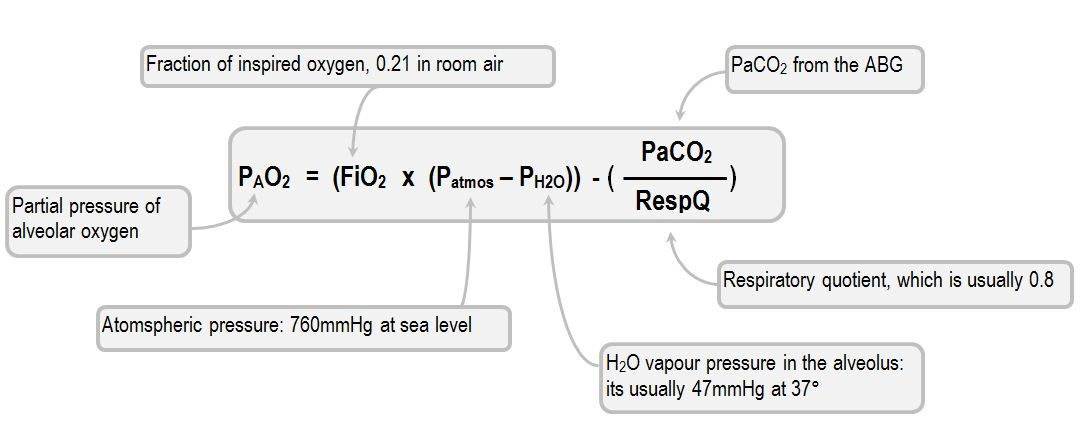
On room air and at sea level, we can assume certain constants:
PAO2 = (0.21 × (760 - 47)) - (PaCO2 × 1.25)
Thus:
PAO2 = (149 - (PaCO2 × 1.25)
In the patient with a relatively normal PaCO2 (say, 40) :
PAO2 = (149 - 50) = 99mmHg
PAO2 at any given FiO2:
| FiO2 21% | 100 |
|---|---|
| FiO2 30% | 164 |
| FiO2 40% | 235 |
| FiO2 50% | 307 |
| FiO2 60% | 378 |
| FiO2 70% | 449 |
| FiO2 80% | 520 |
| FiO2 90% | 592 |
| FiO2 100% | 662 |
For every 10% increase in FiO2, the PAO2 will rise by about 71-72 mmHg.
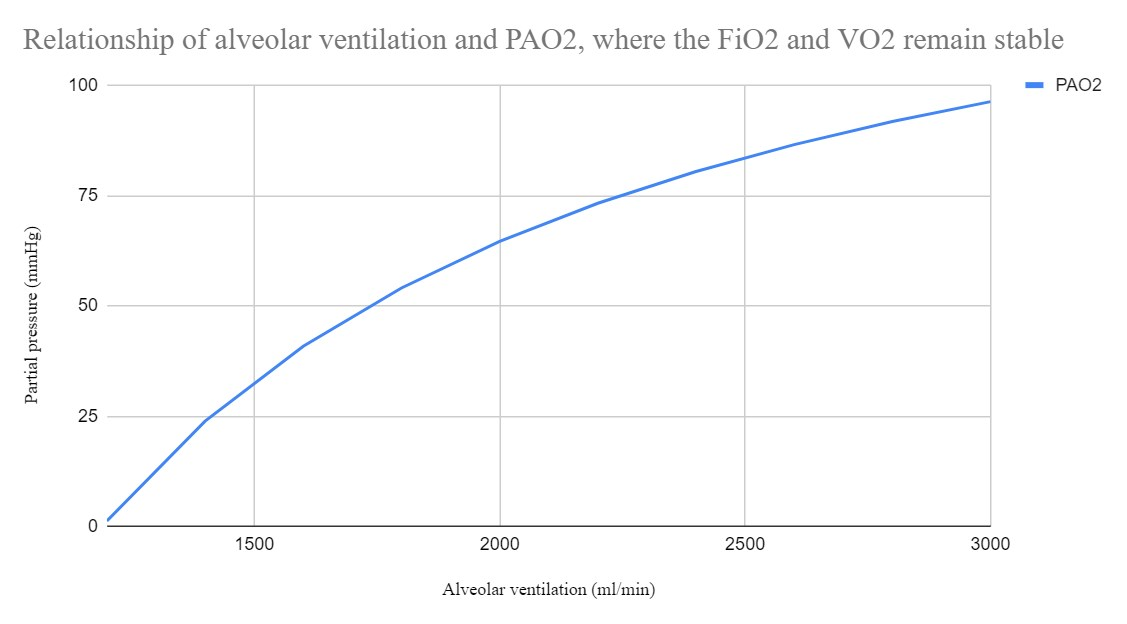
The minute volume multiplied by the difference between the amount of inhaled oxygen and exhaled oxygen is the total oxygen consumption (and if oxygen was not being consumed, that difference would be zero). From this equation, it follows that if the VO2 remains stable (as it does, because organs have got to keep metabolising stuff), and the FiO2 remains stable, then then the fraction of alveolar oxygen must decrease with decreasing VA: