Initial Settings - Quick Reference
| Disease | Mode | Tidal Volume (mL/kg^) | Respiratory Rate | I:E | PEEP | FiO2 |
|---|---|---|---|---|---|---|
| Traditional | A/C | 8 | 10-12 | 1:2 | 5 | 100% |
| Lung Protective (e.g. ARDS) | A/C | 6 | 12-20 | 1:2 | 2-15 | 100% |
| Obstructive (intubation will generally make it worse) | A/C | 6 | 5-8 | 1:4 LONG | 0-5 | 100% |
| Hypovolemic | A/C | 8 | 10-12 | 1:2 | LOW | 100% |
Troubleshooting
D: displaced/dislodged tube
O: Obstruction
P: Pneumothorax
E: Equipment Failure
S: Stacked breaths
Bagging trial - attempt to resaturate via BVM
- low resistance / minimal chest rise = likely displacement
- high resistance: obstruction / stacked breaths (esp. in obstructive lung diseases)
Direct Laryngoscopy:
Overview
3 Major Indications for / Intubation/Mechanical Ventilation
- failure to oxygenate (hypoxemic respiratory failure)
- ARDS, Pneumonia (V/Q mismatch), etc.
- failure to ventilate (hypercarbic respiratory failure)
- Seizure, asthma, drug ingestion, etc
- inability to protect airway
- GCS<8, AMS, lack of cough/gag reflex
Ventilation
- measured by ETCO2 / blood gas
- Determined by RR and Tidal Volume
- increased RR = decreased Co2 // big breath = more CO2 released
- 5-8cc/kg = normal tidal volume
Oxygenation
- FiO2 (fraction of inspired O2)
- .21-1.00 (.21 = room air)
- FiO2 > .50-.60 can lead to oxygen toxicity if used for long periods
- Mean Airway Pressure (Paw)
- influences alveolar recruitment (more pressure = more recruitment = more surface area)
- influence by iTime, eTime, and PIP
- iTime:eTime = 1:2 normally
- PIP = peak inspiratory pressure
- Normal PIP = <25
- PIP > 30 = risk of barotrauma
- PEEP
- minimizes alveolar collapse (closing pressure)
- reflects FRC
- Normal = 5cmH2O
Modes
Ventilation modes - WikEM
Assist Control
SIMV: initiates mechanical breaths and support patient breaths
Pressure Control
- Set pressure, volume depends on lung compliance
Volume Control - Set volume, pressure depends on lung compliance
Settings / Vocabulary
FiO2: the percentage of inspired oxygen, recall that room air is 21% (0.21) at all altitudes.
Mode: see the more detailed discussion below and the graphics above.
Rate: how many mandatory breaths per minute your patient is given is your set rate. Your patient can ‘overbreathe’ at a higher rate, the level of support with these spontaneous breaths is also something that can be set (see discussion below).
Tidal Volume: what volume (measured in cc) is being delivered per breath. SET in volume control modes, VARIABLE in pressure control/support modes.
Pressure Support: How much driving pressure you are giving a patient to assist inspiration. SET in pressure control/support modes.
PEEP: Positive End Expiratory Pressure. This is how much positive pressure the ventilator will still provide during exhalation (the ‘minimum’ pressure that the patient will experience).
Inspiratory Time: length of time spent inhaling. Adjust to maintain at least 1:2 inspiratory:expiratory ratio, and ensure patient is reaching 0 on inspiration and expiration to avoid stacking breaths
- Respiratory Cycle: One full inspiration and expiration
- Respiratory Rate (f): Breaths per minute
- Peak Inspiratory pressure (PIP): The maximum airway pressure reached during inspiration. In pressure control modes, this is the manipulated variable to control how much gas is delivered.
- Tidal Volume (Vt): The volume of each breath. In volume control modes, this is the manipulated variable to control how much gas is delivered.
- Positive End Expiratory Pressure (PEEP): Continuous vent pressure applied to the airway, in order to keep alveoli open.
- Airway pressure (Paw): Instantaneous pressure in the airway (varies during respiratory cycle).
- Alveolar pressure (Palv): Instantaneous pressure in the alveoli.
- Compliance (C): How much pressure is required to push a set volume of air into the lungs. Alternatively, how much lung volume changes when you move between two set pressures.
- Plateau pressure (Pplat): The maximum pressure seen by the alveoli during inspiration. Determined by Compliance and Tidal Volume.
- Airway Resistance (RAW): How much the airways resist flow.
- Inspiratory/Expiratory flow: Measured in liters per minute, determined by airway resistance and the difference between Paw and Palv.
- Inspiratory Time (I-time): The time the vent takes to deliver a breath
- Expiratory Time (E-time): The time it takes to go from the end of one inspiration to the start of another. In other words, how long the vent allows the patient to exhale.
- Inspiratory to expiratory ratio (I:E ratio): Ratio of the time spent during inspiration to the time spent during expiration.
- Fraction of Inspired Oxygen (FiO2): What percent of the delivered gas is oxygen. Room air has an FiO2 of 21%.
- Minute Volume (MV): Total amount of gas moved per minute
Typical respiratory rates for age are set as follows:
| Patient’s Weight (kg) | Age (years) | Rate (bpm) |
|---|---|---|
| 1 | <1 | 25-45 |
| 3 | <1 | 22-40 |
| 5 | <1 | 20-35 |
| 10 | 1 | 20-30 |
| 16 | 3 | 20-30 |
| 19 | 5 | 15-25 |
| 27 | 8 | 15-25 |
| 35 | 10 | 15-25 |
| 45 | 12 | 15-22 |
| 61 | 15 | 12-20 |
| 70 | 18 | 12-20 |
Typical inspiratory times are as follows:
- Neonatal: 0.3-0.5 seconds
- Infant: 0.4-0.8 seconds
- Child: 0.6-1.0 seconds
- Adult: 0.8-1.4 seconds
Typical values for trigger sensitivity are:
| Flow (L/min) | Pressure (cmH2O) | |
|---|---|---|
| Infant | 0.2-1.0 | -1 |
| Child | 0.5-1.0 | -1 |
| Adult | 0.8-3.0 | -2 |
Assist Control (AC), aka Continuous Mandatory Ventilation (CMV)
- SET: FiO2, Tidal Volume, Rate, PEEP.
- THE DETAILS: Your patient gets a mandatory minimum minute ventilation because volume is constant and there are a mandatory minimum number of breaths per minute (the “Control” breaths). If your patient breathes above the set rate, all spontaneous (“Assist”) breaths are fully supported. Every time your patient triggers the ventilator, he gets the FULL tidal volume that you have set. -
PRVC (Pressure Regulated Volume Control), aka Volume Assured Pressure Control
- This is a form of Assist Control mechanical ventilation. It combines a pressure limit (pressure control) with volume assurance, thus guaranteeing a minimum minute ventilation. The ventilator adjusts the pressure from breath to breath, as the patient’s airway resistance and respiratory system compliance changes, in order to deliver the set tidal volume. The ventilator monitors each breath and compares the delivered tidal volume with the set tidal volume and adjusts the inspiratory pressure on the next breath appropriately. -
Synchronized Intermittent Mandatory Ventilation (SIMV or IMV), aka The Surgeon’s Mode.
- SET: FiO2, Tidal Volume, Rate, PEEP.
- THE DETAILS: Similar to AC with one notable difference, only the set breaths are fully supported. If the set rate is 6 and the patient is breathing 12, then 6 of the breaths get the full set tidal volume and the other 6 get no support. You can assist the spontaneous breaths with Pressure Support to overcome the ventilator circuit, if you’d like. If your patient isn’t ready to tolerate Pressure Support alone, then you may as well just rest him on AC. MICU physicians almost never use SIMV. -
Pressure Support
- SET: FiO2, Pressure Support, PEEP.
- THE DETAILS: This is a method of assisting spontaneous breathing. The patient controls all parts of the breath except the pressure limit. You are going to provide a driving pressure to assist inspiration (your Pressure Support, PS) as well as PEEP if you want it. The PS can be adjusted upwards until you support your patient well enough to achieve the tidal volume that you desire. You will often see this used as a weaning mode (see the separate handout on weaning, which follows). Remember that higher levels of PS are mechanical ventilation, NOT weaning.
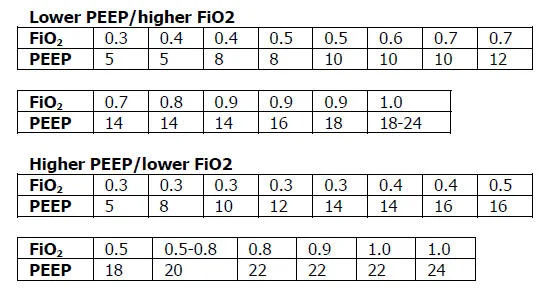
ARDS Specifics
- High PEEP = more alveolar recruitment
Pediatric Specifics
Intro to Pediatric Mechanical Ventilation
Ventilator Simulator - OPENPediatrics
ET Tube Size (cuffed):
- Age/4 +3.5 (max out at 7.5/8)
- Always use cuffed tube, even in infants/neonates! (small tubes will be “lo-pro” tubes)