quick reference
- Most prevalent in adults aged 40–50 years, women > men
- Fatigue, jaundice, pruritus, right upper quadrant discomfort, or weight loss
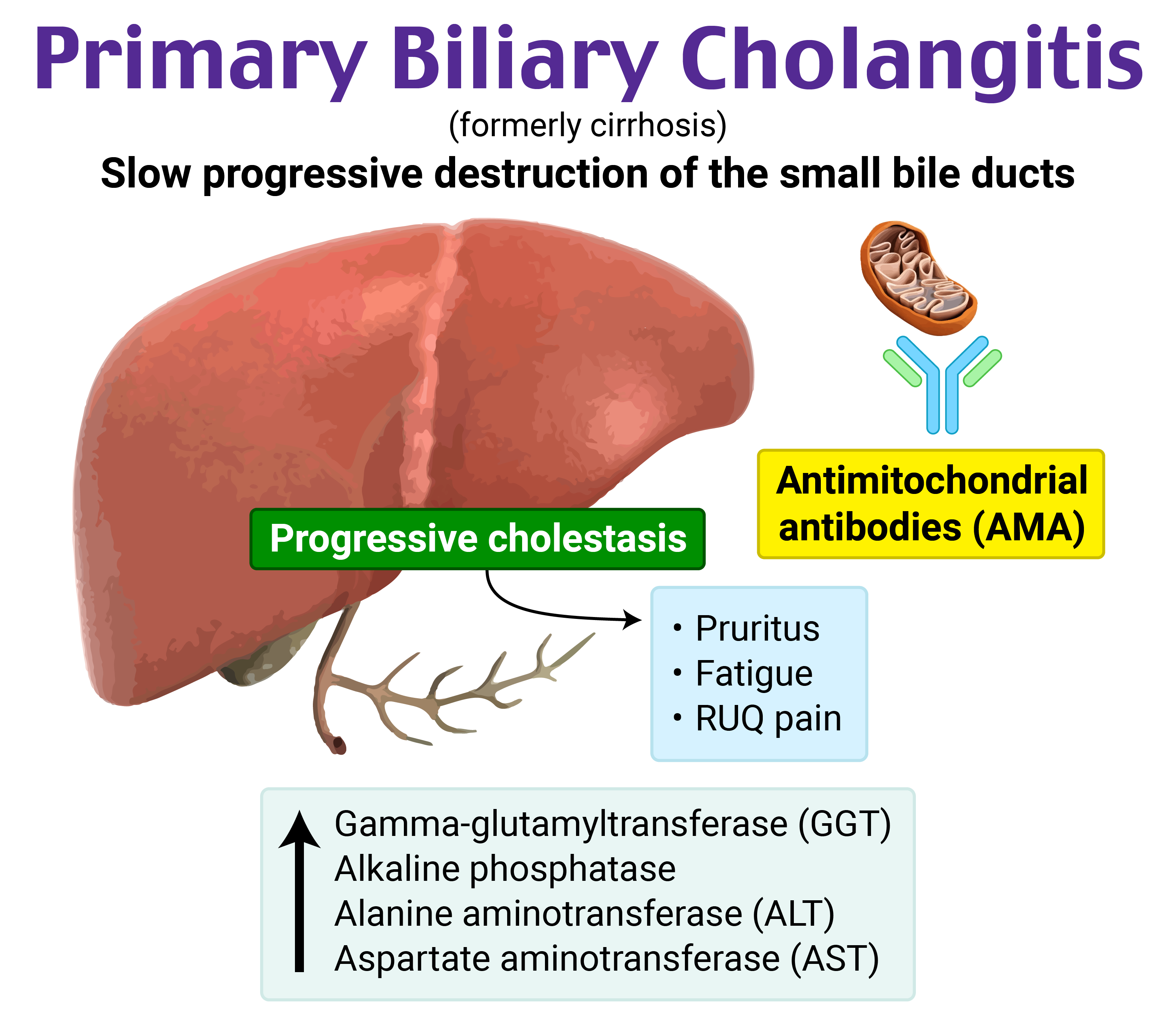
- Labs will show antimitochondrial antibodies (AMA)
- Most commonly caused by an autoimmune T-cell-mediated attack on the intralobular bile ducts
pathophysiology
Primary biliary cholangitis is a chronic progressive autoimmune disease that affects the intrahepatic bile ducts.
- causes chronic cholestasis (decreased flow of bile) and can result in cirrhosis.
epidemiology / etiology
- Much more common in women (approximately 90%) and is
- most often diagnosed between 30 and 65 years of age.
clinical features
The diagnosis of primary biliary cholangitis may be initially suspected due to abnormal liver biochemical tests in asymptomatic patients or patients may have clinical manifestations from cholestasis, such as pruritus, fatigue, right upper quadrant discomfort, and jaundice.
diagnosis
Primary biliary cholangitis should be suspected in adults who have an elevated alkaline phosphatase without extrahepatic biliary obstruction.
Other supportive laboratory findings include
- elevated antimitochondrial antibody
- elevated antinuclear antibody
- elevated high-density lipoprotein
- elevated gamma-glutamyltransferase, and elevated 5-nucleotidase.
The diagnosis of primary biliary cholangitis is established in patients who have at least two of the following in the absence of extrahepatic biliary dilation or comorbid liver disease:
- an alkaline phosphatase elevated to at least 1.5 times the upper limit of normal
- antimitochondrial antibody titers elevated to at least 1:40
- histologic evidence of primary biliary cholangitis (nonsuppurative destructive cholangitis and destruction of interlobular bile ducts)
Patients can be evaluated for extrahepatic biliary dilation with a right upper quadrant abdominal ultrasound
treatment
Medication: Ursodeoxycholic Acid
- Recommended adult dosage:13-15 mg/kg/day administered in two to four divided doses with food
All patients diagnosed with primary biliary cholangitis should be referred to a hepatologist.
Patients with primary biliary cholangitis should abstain from alcohol.
Ursodeoxycholic acid is recommended for all patients with primary biliary cholangitis because it improves long-term survival, slows disease progression, and improves liver biochemical tests. Patients with primary biliary cholangitis require routine monitoring of the following laboratory studies: aspartate aminotransferase, alanine aminotransferase, alkaline phosphatase, total bilirubin, platelet count, prothrombin time, thyroid-stimulating hormone, vitamin A, and vitamin D.