quick reference
Adult Mx Rate:
- (Weight in kg) + 40 = ml/hr
- dextrose is to prevent catabolism, not feed
Adult Bolus: 1L
fluid - general
Total Body Water (TBW) = 0.6 x weight (kg)
- Of which, 2/3 is intracellular and 1/3 extracellular
- 1/4 of extracellular is vascular (1/12)
Hypertonic
- 3% hypertonic saline
- sodium repletion and increased ICP
Isotonic
- sodium repletion and increased ICP
- NS
- LR
- Plasmalyte
Hypotonic - D5W 1/2NS
- D5W
| Fluid | Osm | Na | Cl | Glucose(g/L) | pH | Buffer | K | Ca | Mg |
|---|---|---|---|---|---|---|---|---|---|
| Plasma | 289 | 140 | 103 | 7.4 | HCO3 22-32 | 4 | 5 | 2 | |
| Normal Saline (NS) | 308 | 154 | 154 | 0 | 5.0 | 0 | 0 | 0 | 0 |
| D5NS | 560 | 154 | 154 | 50 | 0 | 0 | 0 | ||
| Lactated Ringers | 273 | 130 | 109 | 0 | 6.5 | Lactate 28 | 4 | 3 | 0 |
| Plasmalyte | 295 | 140 | 98 | 0 | 5.0 | Gluconate 23/Acetate 27 | 5 | 0 | 3 |
| D5 1/2NS | 406 | 77 | 77 | 500 | 4.5 | 0 | 0 | 0 | 0 |
| D5W | 252 | 0 | 0 | 50 | |||||
| 5% Albumin | 309 | 130-160 | 130-160 | 6.4-7.4 | <1 |
bolus
- Bolus: give for symptomatic acute hypovolemia or shock
- Orthostatics
- Skin turgor
- POCUS - IVC collapsibility
Peds: 20mL/kg
Adults: 1L (in general)
Considerations: - HF
- A-fib
- small, frail,
maintenance rate
Maintenance: indicated when a patient cannot meet daily water and electrolyte needs enterally, but is hemodynamically stable and not volume depleted.
- Holliday Segar method - official
- In reality: 4-2-1 method
- Patients > 40kg
- (Weight in kg) + 40 = ml/hr
- Math:
- First 10 kg: 4 mL/kg/hour.
- Next 10 kg (11-20 kg): 2 mL/kg/hour.
- Over 20 kg: 1 mL/kg/hour
- Patients > 40kg
hyperchloremic acidosis
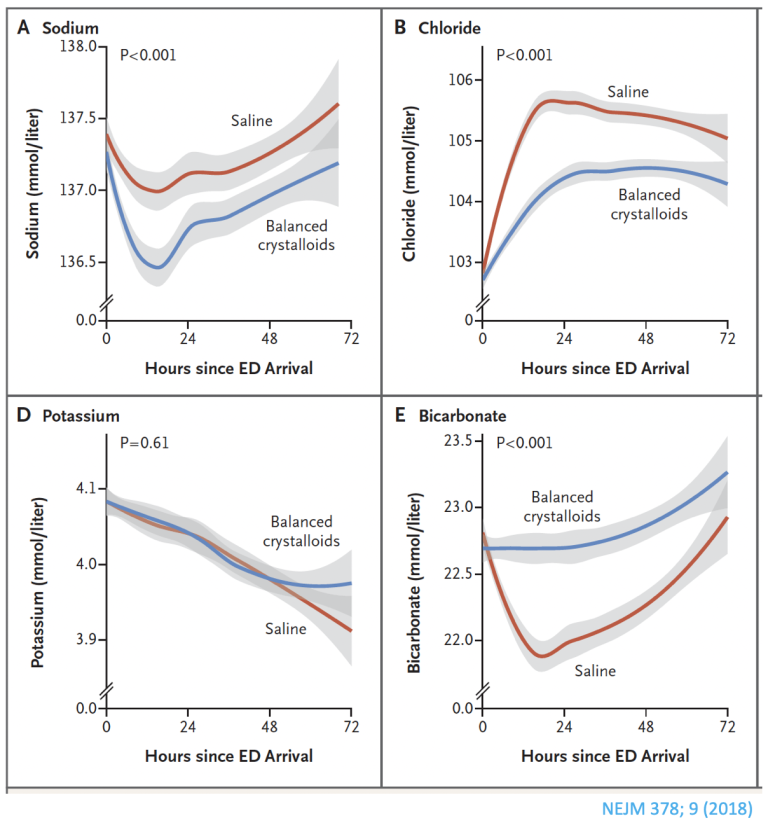
Previous post reviewed the safety of balanced crystalloids in hyper K. But what was up with serum bicarbonate decreasing with saline administration?
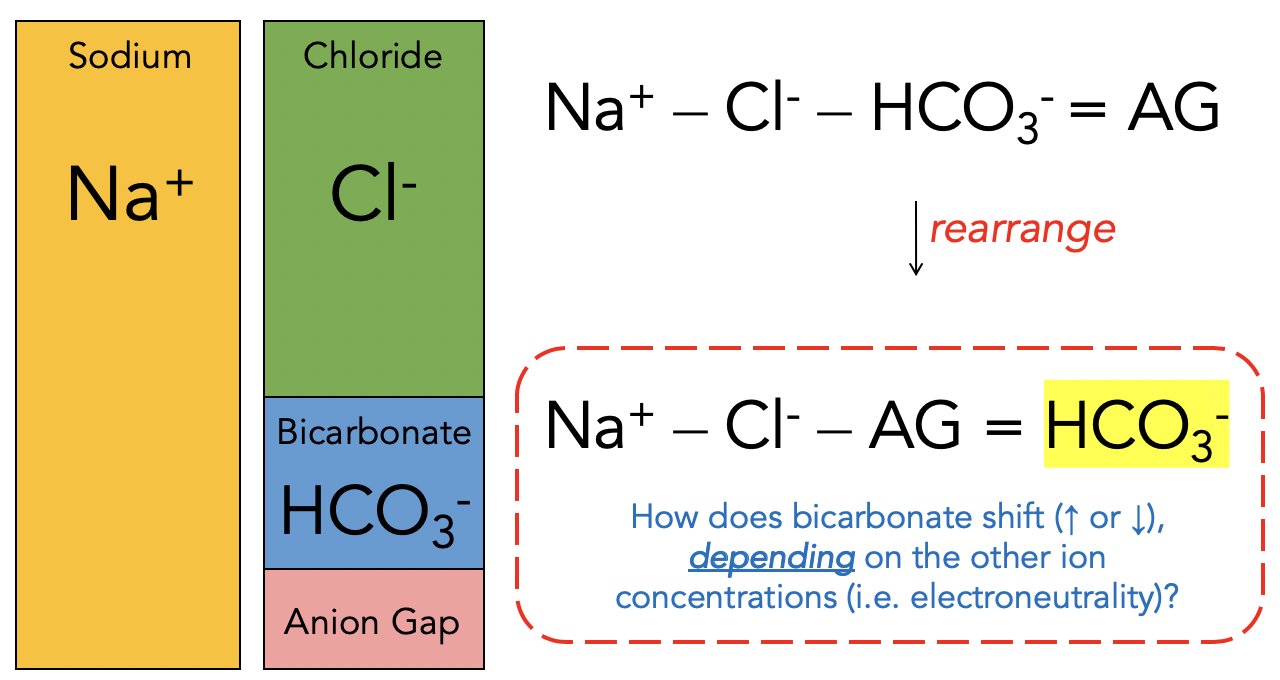
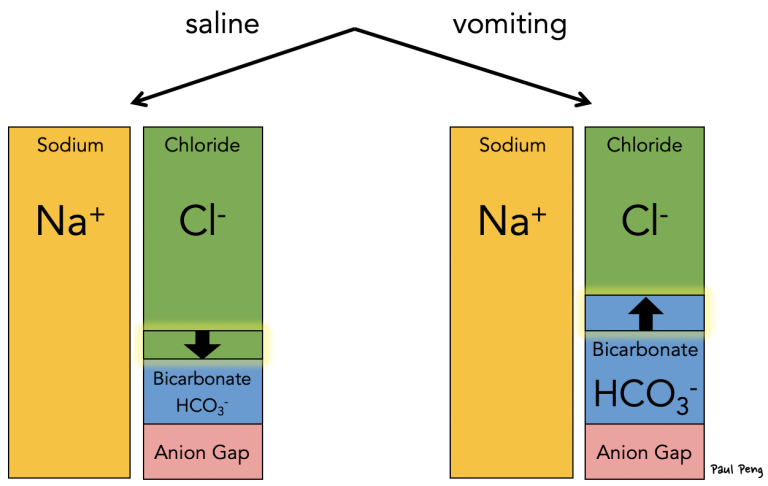
Now consider if saline is given which has higher Cl- content; or if a patient has vomited a lot, which decreases gastric H+ and Cl-:
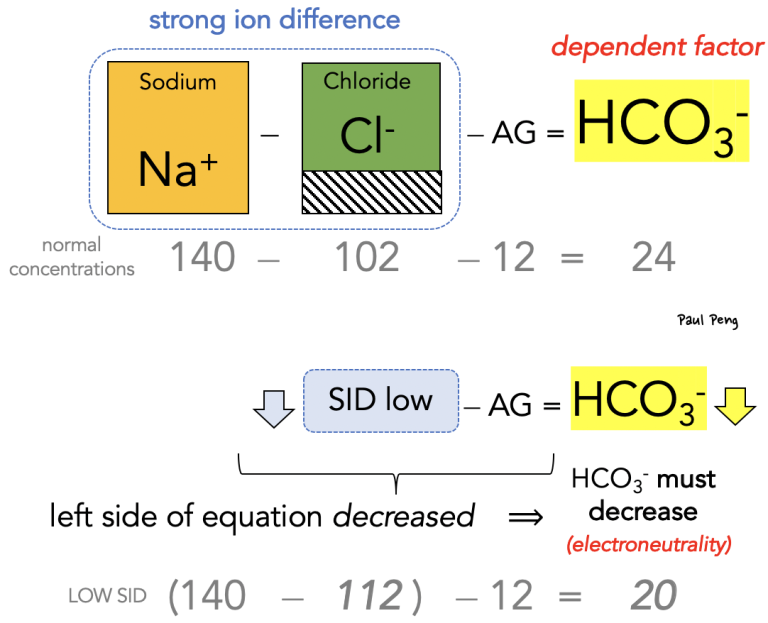
Considering bicarbonate as a dependent variable is one of the concepts behind the Stewart approach to acid-base physiology, as opposed to the more familiar Henderson-Hasselbalch. The Stewart approach also places emphasis on the strong ion difference (SID). Here is my approach to thinking about acid-base:
On a related note, what is contraction alkalosis?
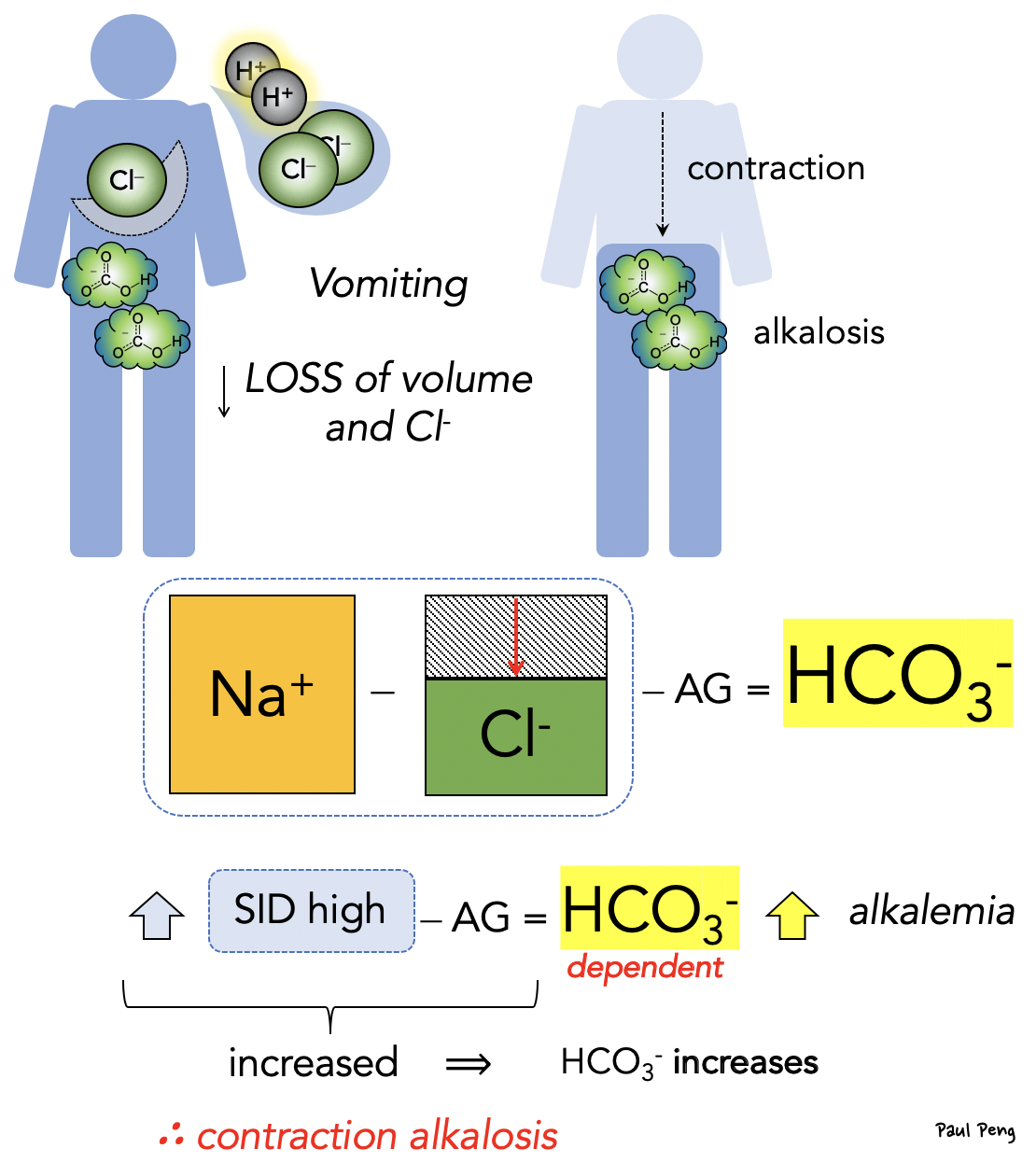 Not only is there less volume for the remaining bicarbonate (hence a higher concentration), but the loss of chloride leads to a higher SID, which is balanced by an increase in bicarbonate, causing a (contraction) metabolic alkalosis.
Back to saline and hyperchloremic acidosis…
Hyperchloremia also causes RENAL VASOCONSTRICTION. This is possibly contributory to the higher incidence of major adverse kidney events at 30 days in patients who received normal saline (SALT-ED trial):
colloids
PRBCs
Studies
SALT-ED
Balanced Crystalloids versus Saline in Noncritically Ill Adults | New England Journal of Medicine